
There's a particular kind of quiet panic that hits a newly qualified psychologist. It shows up right after the first real client walks out the door. You sit back down. The room goes still. And you think: okay, so what do I actually write now?
Training covered the theory, sure. You talked through case examples with your supervisor. But "how do I write this note, today, for this specific person" is a question most of us end up answering completely alone.
This post is here to help with exactly that. Below are 7 example templates across 7 different session types, useful whether you're seeing your third client or your three-thousandth. Every example is fictional. But all of them reflect situations therapists genuinely run into.
What Are Therapy Session Notes?
The short version
A therapy session note is the clinical record you write after each meeting with a client. Not a transcript. A focused summary of what happened, how it connects to the treatment plan, and what comes next. It might follow a structured format like SOAP or DAP, or it might be a freer narrative. The point is always the same: capture enough to continue the work later without starting over.
It's worth knowing that two kinds of notes often sit side by side. There's the progress note, which documents the clinical work and may be shared in supervision or with another provider. And there's the more private process note, the one you keep for yourself, where the hunches and half-formed questions go. The templates below cover both.
Why Do Session Notes Matter?
Session notes are more than paperwork. Three reasons, really.
First, continuity of care. Come back to a case after a three-week gap, or hand it to a colleague, and the note is what lets treatment pick up where it left off. Without it, you start from scratch. Everybody feels that.
Second, they sharpen your own thinking. Writing forces you to pull apart what you observed from how you read it, and to commit to a concrete plan for next time. It's surprising how often the plan only becomes clear once you're made to write it down.
And third, there's the professional weight. Notes are what you bring to supervision. They may also form part of your legal and ethical record of care. Not the fun part of the job, no, but the part that speaks for you if it ever has to.
What Makes a Good Session Note?
Whatever format you land on, a good note answers three questions.
What happened in this session? Both what the client brought and what you noticed.
Where does this session sit relative to the last one? Progress, a plateau, or a step back?
And what will you do next time? That last answer is a roadmap for you. Shared in supervision, it's also a window into how you think about intervention.
Answer those three, and the note is doing its job. Structure barely matters after that.
Three months later
A client comes back after a long break, or you're prepping for supervision on a case you haven't touched in a while. You open the note. It says: "Talked about various issues, client seemed better." That's it. Now you're reconstructing the whole thread from memory, and the memory is thin. A note anchored in something concrete — a Beck score, a specific homework result, the exact thought you worked on — hands you the thread instantly. The vague note costs you the first ten minutes of the next session.
When Should You Write Session Notes?
The honest answer: right after the session ends. Within ten minutes, ideally. Memory decays fast, and it decays in a specific way. The vivid, specific observations go first, and vague generalities quietly slide in to replace them. Wait an hour and you won't even notice the swap has happened.
In the real world, of course, this isn't always possible. Back-to-back clients, a walk-in, a phone call you couldn't dodge. When you genuinely can't write the full note in the moment, do the next best thing. Drop two or three keywords into your phone or app right away, somewhere secure and encrypted, and let those triggers carry the memory through to the evening when you write it up properly.
The note you meant to write
You finish a session at 4pm and tell yourself you'll write it up after the last client leaves. Then a colleague catches you in the hallway, the last session runs long, and by the time you sit down it's 7pm. You stare at the blank field. The subway panic attack the client described? You remember there were two incidents, but not which came first, or which thought showed up in both. Ten seconds of keywords at 4:03 would have saved all of it. That's the whole case for jotting something down right away.
How to Write Therapy Session Notes: 7 Ready-to-Use Templates
The fastest way to learn is to watch the format doing its thing. Below are seven templates covering the session types clinicians write up most often, from individual CBT all the way to supervision. Find the one that fits your approach, borrow the wording, and use it the same way every time. Consistency is more than half the battle here.
Template 1: Individual CBT Session (DAP Format)
Client: E. Kaya, Session 8
D: Reports having experienced two panic attacks this week. The first was on the subway, the second in a work meeting. Has been keeping a thought record and noticed that the thought "I'm going to lose control" appeared in both incidents. Continuing with the exercise program. Sleep is regular.
A: Avoidance behavior in panic disorder is decreasing. Cognitive restructuring techniques appear to be internalized. Insight is growing.
P: Next session: plan in vivo exposure exercise (riding the subway alone). New thought record assigned as homework.
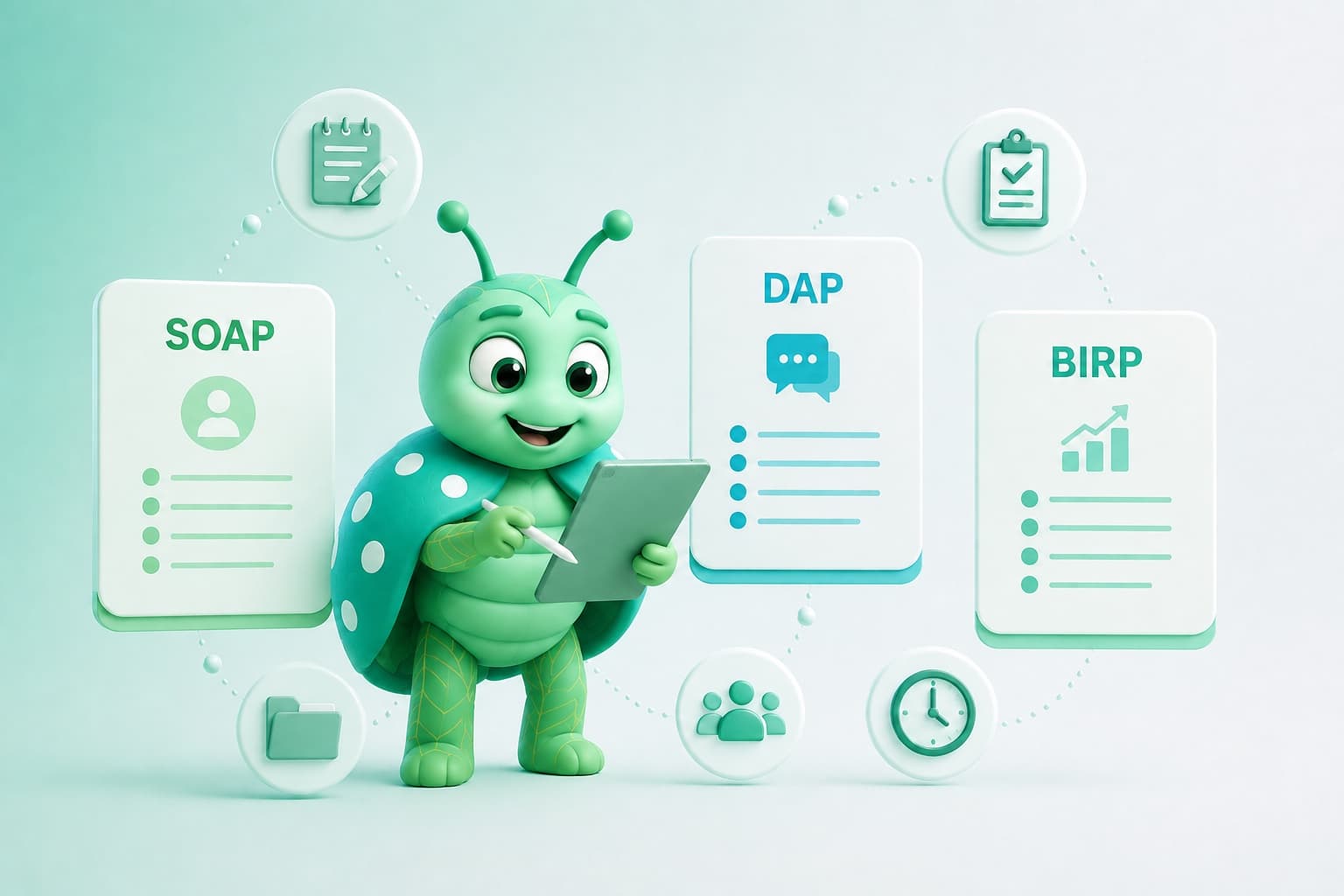
If DAP versus SOAP is still a live question for you, our full guide to SOAP, DAP, and BIRP notes breaks down when each one earns its keep.
Template 2: Intake / First Session (Extended Format)
Client: A. Yılmaz, first session
Presenting concern: Increasing work-related anxiety over the past six months, sleep problems, social withdrawal.
Current status: Generalized anxiety symptoms are prominent. Beck Anxiety Inventory score: 28 (moderate-high). No suicidal ideation, but expresses "everything feels very hard." General functioning moderately impaired.
History: Completed 8 months of CBT in 2022 with benefit. Family history of depression (mother). No current medication.
Formulation: A presentation in which perfectionist schemas are activated, with workplace ambiguity serving as the trigger for elevated anxiety.
Plan: Weekly sessions, CBT-focused. Initial goals: anxiety management techniques and sleep hygiene. Treatment plan to be reassessed after three sessions.
A first session goes smoother when the groundwork is already done. If you don't have one yet, here's how to build a therapy intake form that feeds straight into a note like this.
Template 3: Couples Therapy Session
Clients: B. and C. Demir, Session 5
Session focus: Structured review of the argument from last week (financial matters).
B's perspective: Expressed that he/she finds their partner's spending "out of control," has raised this repeatedly, but feels unheard.
C's perspective: Said that their partner is constantly "monitoring" them and that their own financial contributions go unacknowledged.
Intervention: Speaker-listener technique was used. Both parties were guided to express their feelings using "I" statements.
Response: Tone softened in the second half of the session. C saying "I hadn't realized, I'm sorry" was an emotionally significant moment for B.
Plan: Recommended setting aside a structured 30 minutes each week for budget discussions. Next session will shift to the theme of intimacy.
Template 4: Child Therapy Session (Play Therapy)
Client: D. (age 8), Session 4
Session themes: Control, protection, visibility.
Observation: In the sand tray, first built a house, then constructed a high wall around it. Placed "me and my dog" inside the wall; placed the mother and father figures outside. Said: "When they shout, it stays quiet in here."
Interpretation: The conflict at home appears to have created a need for a refuge in the child. The protective role assigned to the dog figure is notable.
Parent communication: In a 10-minute meeting with the mother, it was shared that D. was involved in a fight at school last week. Information received that arguments at home have decreased.
Plan: Next session: work with emotion cards. An additional session on boundary-setting techniques recommended for the mother.
Template 5: EMDR Session
Client: F. Aksoy, Session 7 (3rd processing session)
Target memory: A traffic accident at age 16, watching the client's mother being injured in the front seat.
Starting SUDs: 8/10 Negative cognition: "I am helpless" Positive cognition: "I am safe now" VOC: 3/7
Processing: 6 sets of bilateral stimulation completed. Crying observed after the third set. A new memory surfaced after the fifth set (waiting at the hospital after the accident). Processing slowed at this memory.
Closing SUDs: 4/10 VOC: 5/7
Plan: Continue with the hospital scene in the next session. Reinforce safe place exercise in the intervening week.
Template 6: Group Therapy Note
Group: Social Anxiety Group, Session 6 (of an 8-session module)
Attendance: 7/8 members (E. gave advance notice of absence)
Theme: Sharing exposure experiences.
Group dynamics: Energy was low in the first half; most members opened with "it's been a hard week." One member (A.) shared the experience of giving a presentation at the office; this sparked momentum in the group. Three other members wanted to contribute similar experiences.
Intervention: Structured sharing round focused on making success experiences concrete.
Individual notes: A. (marked progress); B. (arrived late, remained quiet); F. (shared their own experience for the first time).
Plan: Next session: relapse prevention strategies.
Template 7: Supervision Note (For Yourself)
Case: M. Arslan, Session 12 Supervisor: Dr. Kaya Meeting date: [date]
Topic I brought: The therapeutic alliance with this client is strong, but over the past three sessions, transference themes have intensified. The client has begun projecting their relationship with their mother onto me. I asked how to work with this.
Supervisor's suggestions: Begin with a gentle interpretation to test whether the client is ready for this material to be interpreted. Keep an additional personal note stream to monitor my countertransference. Bring progress to the next supervision.
Outcome: Noted two new openings regarding my work. Will start the countertransference journal this week.
What to Watch Out For When Writing Session Notes
A handful of traps come up over and over. The good news? Once you can name them, they're easy to sidestep.
Blurring observation and interpretation. "The client cried" is an observation. "The client is grieving" is your read on it. Keep the two on separate lines, or in separate fields, so a future reader (which might well be you) can tell what actually happened apart from what you inferred.
Vagueness. "We talked about various issues" tells you exactly nothing come November. Every note needs an anchor: a specific event, a score, a homework result, the intervention you reached for.
Writing too much. A note is a working tool, not a memoir. Get down what matters for continuity and clinical reasoning. Then stop.
Treating confidentiality as an afterthought. Session notes hold some of the most sensitive data a person will ever hand over. They belong in a secure, access-controlled system, kept in line with your local data-protection rules. Our guide to KVKK and GDPR compliance for therapists goes deeper here. A notebook on the desk or an unencrypted spreadsheet isn't a system. It's a risk.
Benefits of Keeping Consistent, Structured Session Notes
What ties all seven templates together is simple. Each one splits observation from interpretation, makes progress trackable, and points you at the next step. Pick any of them, use it consistently, and the payoff shows up in ways you can actually feel:
- Progress you can see. Movement, a plateau, a step back. It's all visible across sessions at a glance.
- Faster prep. You walk into each meeting already knowing where you left off.
- Better supervision. A clear note is the raw material for a genuinely useful hour with your supervisor.
- A record that holds up. If you ever have to account for your work, structured notes do the talking.
Consistency is the quiet ingredient. It's what turns a folder of notes into a real tool when you open it three months down the line.
A Quick Checklist
Reviewing how you write and store your notes? This is a fair place to start:
- You write each note within about ten minutes of the session ending.
- Observation and interpretation live in separate lines or fields.
- Every note is anchored in something concrete (a score, an event, a homework result).
- You use one consistent format per session type (SOAP, DAP, or a set narrative).
- Each note names a plan for the next session.
- Progress notes and private process notes are kept separate.
- Notes are stored encrypted, with role-based access, not in a notebook or shared file.
- Backups run automatically on a regular schedule.
Writing and Storing Session Notes with Calemio
Calemio holds all of these templates in one place. Notes are encrypted end to end and locked at the session level. They're never used for AI training, under any circumstances, ever. And each note sits on the client's own record, right next to their history and their upcoming appointments, so continuity is just there instead of something you rebuild from scattered files.
Moving off the notebook and onto a system means documentation that's safer and more consistent, for you and for your clients both. You can download and try it for free.
Frequently Asked Questions
How do you write a therapy session note?
Start by answering three questions: what happened this session, how it relates to the previous one, and what you'll do next. Separate your observations from your interpretations, keep it concrete, and choose a format such as SOAP, DAP, or a brief narrative. Then use that same format consistently across sessions.
What is the difference between SOAP and DAP notes?
SOAP splits the note into Subjective, Objective, Assessment, and Plan, which suits settings that track measurable data. DAP collapses the first two into a single Data section, followed by Assessment and Plan, which many therapists find quicker for talk-therapy work. Both keep observation, clinical judgment, and next steps clearly separated.
When should you write session notes?
Ideally right after the session ends, within about ten minutes, while details are still fresh. Memory fades fast, and delayed notes tend to drift into vague generalities. If you can't write the full note immediately, jot down two or three keywords in a secure place and expand them the same day.
How long should a therapy session note be?
Long enough to capture what matters for continuity and clinical reasoning, and no longer. A note is a working tool, not a transcript. For most sessions a focused summary of the presentation, your assessment, and the plan is enough; over-documenting wastes time and buries the important details.
Are therapy session notes confidential and how should they be stored?
Yes. Session notes contain highly sensitive personal data and must be protected from unauthorized access. Store them in an encrypted system with proper access controls and backups, in line with your local data-protection rules, rather than in a paper notebook or a shared spreadsheet.
What is the difference between a progress note and a process note?
A progress note documents the clinical work and may be shared in supervision or with other providers, so it stays focused and factual. A process note is your private reflection, capturing hunches, countertransference, and questions you want to explore. Keeping them separate protects the client and keeps your official record clean.
Related articles


Start using Calemio for free
Encrypted, compliant and simple. Built for independent therapists and clinics.
Start free